Monday, 7 October 2024

"What Adults Forget About Friendship" by Rhaina Cohen for The Atlantic

"Kids’ time together is often dedicated to play. For many children, all they need to entertain themselves is shared space, the right companions, and their imagination. But this is not just a pastime; it’s a vulnerable way to connect with someone, Jeffrey Parker, a psychology professor at the University of Alabama, told me. After analyzing more than a decade’s worth of recorded conversations between children and their friends, Parker noticed a common dynamic: If one kid introduces an unexpected idea, the other must riff to make it work. Doing this with a new playmate is a “high-risk strategy”—maybe they’ll shut you down—but when your ideas mesh, you get to invent something new together."

Link to the Article

Monday, 19 November 2018

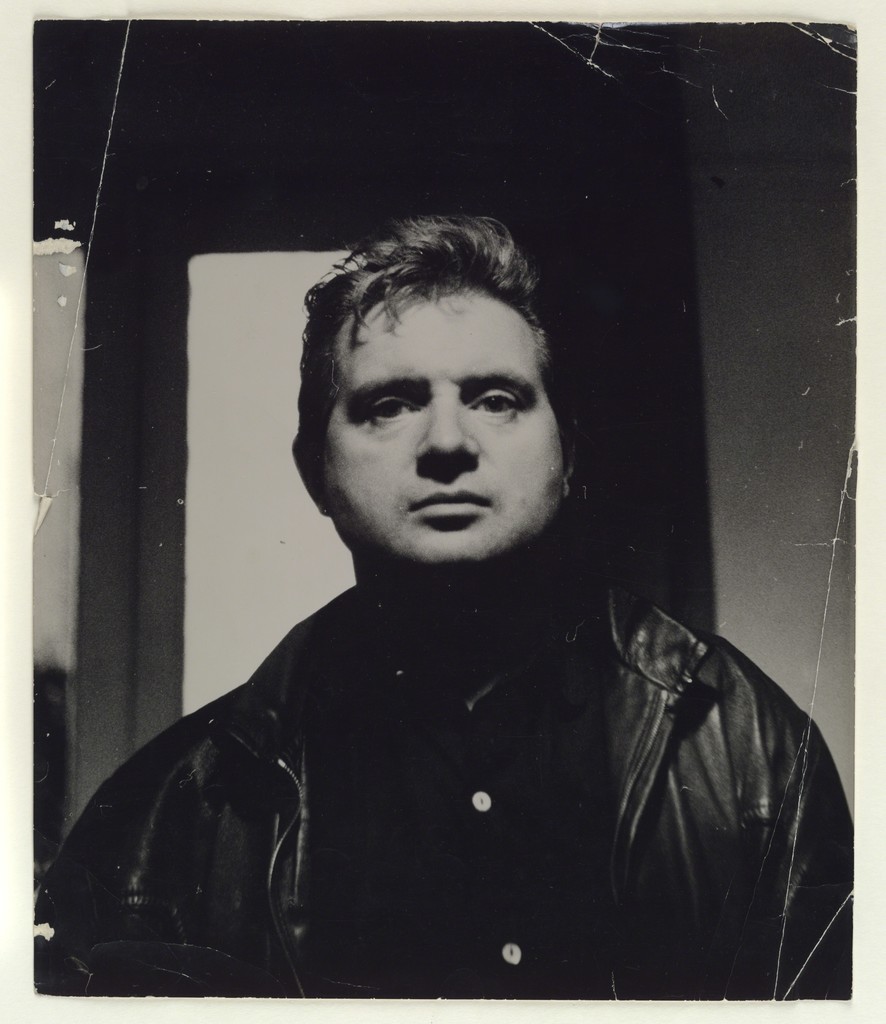
Francis Bacon on How to Be an Artist


“I want a very ordered image, but I want it to have come about by chance,” he told Sylvester in the same 1966 interview. He believed that through embracing spontaneity—and accepting “accidents” as integral aspects of the composition—he’d achieve true emotional candor. Spontaneous marks and images, for the artist, resembled the unexpected welling up of passionate, unbridled feelings."

Read the full article in Artsy

Sunday, 8 July 2018

"Every child is an artist. The problem is how to remain an artist once he grows up" 
- Pablo Picasso 

"In every real man, a child is hidden that wants to play."
- Friedrich Nietzsche 

Wednesday, 26 March 2014

The Future, by Clarke and Fuller


«If humans are not required to earn a living to be provided survival needs, many are going to want to be productive, but not at those tasks they did not choose to do but were forced to accept in order to earn money. Instead, humans will spontaneously take upon themselves those tasks that world society really needs to have done».
- Buckminster Fuller

Original post by the Zeitgeist Movement (26/03/2014)

Saturday, 16 November 2013

What makes us human? Doing pointless things for fun


Silly Walk march in Brno, Czech Republic (2014), inspired by the Ministry of Silly Walks by Monty Python


"Playfulness is what makes us human. Doing pointless, purposeless things, just for fun. Doing things for the sheer devilment of it. Being silly for the sake of being silly. Larking around. Taking pleasure in activities that do not advantage us and have nothing to do with our survival. These are the highest signs of intelligence. It is when a creature, having met and surmounted all the practical needs that face him, decides to dance that we know we are in the presence of a human. It is when a creature, having successfully performed all necessary functions, starts to play the fool, just for the hell of it, that we know he is not a robot."
Continue to read in New Statesman

(http://www.newstatesman.com/2013/10/plays-thing)

Monday, 13 August 2012

David Lynch, on being an artist


"Forget being the best of anything. That's the fruit of the action, and you do the work -they say- for the doing, not the fruit. You can never really know how it's gonna turn out in the world but you know if you enjoy doing it. And ideas start flowing and you start getting, you know, excited about stuff. Then you're having a great time in the doing and that's what it's all about. If you don't enjoy the doing, then do something else."

Sunday, 15 November 2009

Early Developments [Homo Sapiens - Homo Ludens]

This action (performance + manifest), was developed in 2007. One year before, there was an embrionary work developed by me heading to it.
The work of Johan Huizinga is fundamental for the comprehension of the importance of "play" in our culture. This was the main inspiration for the video art work "Homo Sapiens - Homo Ludens".

Monday, 21 May 2007

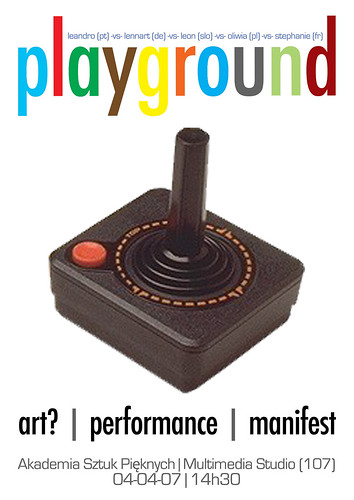
Some things about the performance...

The performance background is the playground manifest.
The video game Street Fighter 2 was used as a tool. It was being projected on one canvas which was always painted by the defeated player.
This performance was a game. The video game was one part of it, which could be replaced by some other else (chess for instance). Street Fighter 2 seemed one good option.
This action was not one attempt to imitate children. To be clear about that the element alcohol was included.

-check the photos and video-


Sunday, 6 May 2007

Playground: Manifest (EN)

PLAYGROUND (English)


Introduction


Paraphrasing a Portuguese philosopher, Agostinho da Silva, Man was not born to be enslaved, but to be an unleashed poet.
That curious, creative, dreamer child, that one day lived inside us, no longer exists. And why? It is a natural fact that in life all children pass to the adult phase and become conscious individuals of their own existence, yearning for the occupation of their place in the world. And, what it is our place in the world? Where is it? How do we know it?
Contemporary society is living in an ideological paradox. The adopted economic system, [considered] being the most viable, is [
supposedly] supported on ideals of freedom and democracy and while simultaneously on a pyramid, castrator of these same ideals. More It is all more like a struggle for survival. This this system, survives with the existence of slave-volunteers, human beings in composing the base of the pyramid, that wait while waiting their ascension in that pyramid.


Technocracy and Utilitarianism…


In a pyramidal society dominated by technocracy and utilitarianism, the competition is considered beneficial, a surplus an added value, and group-work is valued while paradoxically cooperation [— working in a group].
The group, seen incessantly, as a form to obtain a greater and faster production, is submitted to traditional technical protocols being obliged to execute them without any place for the useless, and even less a place space for the error — that which curiously had offered us a great part of our knowledge. Also art suffers with this stigma.
Not having existing place for the useless, the curiosity, the dream or the error that permits allow us to learn,
[also] there is not a place for the creation of new possibilities. The It is preferred the purist [quasi-puritan] crossing of that which what already exists is thus preferred, appealing to resorting on the technical control.
Even tough Even if the scientific method keeps offering us its probabilities, the experimentation continues blocked in its flanks not being able to create facilitating the creation of more [/new] possibilities.
The fate of the World is thus at in the hands of a dictatorship of Technique. Man, [while] becoming further from its individuality, is not born anymore to be a poet, but [instead] to be one useful technician useful to the society.


Creativity I: the Error, the Drift


The famous expression Errare humanum est, followed the technological progress of occidental western society. The Globalization carries today this affirmation to the World, using it as an excuse for the failure of great human projects such as Liberty.
To think The idea that Man needs to forgive himself for being human, seems completely ridiculous if we think that no other animal does it. A dog will never stop being canine, and a cat to be feline. But Man wants to stop being human! He wants more!
The Error is seen therefore as a limitation of human being, who incapacitates the man to reach a more deificated deified platform. It seems to me however contradictory, to think of Error in this way, when throughout all of human history, Error appears as the most creative form, the most sublime tool of the human creation. I do not think therefore that to miss fail (incurring in the error) is the worse thing among the characteristics of human beings.
The Drift [(Dérive)] is directly connected to the random aleatory, and therefore also to Error. Many
examples can It is possible to be analysed throughout all of the history of art many examples, as many technical drifts, as conceptual, or such others as the drift through the cities practiced by the Situationists.
The Drift is an intellectual process that is often underestimated, only because of the connection to Error.


Creativity II: the Barriers and the Limitations


All of being, because it lives and it is sensible, is born limited.

All beings are born limited because they live and are sensitive.
The Physical barriers are already limits
supposedly limitations to human free will.
The Laws, norms and rules, create more laws, norms, rules and disturbed conducts. The Life seems more and more restrictive! The Children stop being children and are put in the school to be standardised. To the most special, it is demanded that they become specialised. The Parents can not be parents any more, because they have to work. Family? Time, time time, where is the time? There is no time! Youth suicides increase. It increases the pessimism in the future. All the ways seem blocked. Freedom? Future? A system exhausted, eroded and without more references. Where are the machines that the futurists were speaking used to talk about? Where are the enslaved slave [/servant] machines? Are they the clocks, the mobile phones, the computers? Are they the Press, the Radio, or the Television? Will be this be the future? The fear, the terror, the fragility created inside of protective barriers?


Art and Play (playground)


The word "Brincadeira", can be perhaps translated into English as "Children's Games" Child's play.
The word that seemed more to me more illustrative
to me for this case it was the place for of the activity, (recreio) the Playground in English, (for proximity due to "brincar" = to play, to toy, to joke).
Paraphrasing, Johan Huizinga, professor and Dutch historian, the culture was born [while] playing (with[/at] the playground). And this one is therefore older than that one the other.
To play is an activity that we all know, but that which we consider as childish. The word acquires most of the times a depreciative derogatory character, because it is seen as opposing the work
[(an obstacle)]. They are assumed There's the assumption that who does not work, plays, amuses himself and therefore does not produce.
It is Because there is a preconception [/prejudice] about playing [(child's play)], that never it does not receives receive due attention especially to its enormous creative potential.
To play is perhaps the most primary human intellectual activity of the Man, perhaps [the] most creative, therefore because it is not about a forced production. Amusement, (to have fun), is the main goal and the main characteristic. It is probably the most all about pure intellectual pleasure.
The Art as being part of the culture is therefore, coming from the play (playground).
Although the Art has used (the play), the aesthetic of child production (for example drawings) in the production of some aesthetics, never was the playground claimed as the origin of the artistic production.
The Therefore Art is now more close closer, to the playground and further from a forced production that does not possess any diversion fun or pleasure.
Contemporary art, can now know acknowledge its reasons, and find a fusing melting point [(being liquid)].
Shall Let get free now, the thinker-child,
the philosopher-practitioner, the artist-creator be freed.


..... ..... ..... ..... ..... ..... ..... ..... ..... ..... ..... ..... ..... .....


I want to play! I want to play. Ei ei ei Hey hey hey!
The system should work for me. I only want to be creator.
I want to play, to be able to draw. To jump, to play a game or to think.
Perhaps today to only to contemplate…
I do not want plus again a forced, frustrated, limited production…
I want amuse myself and to paint and to sculpt if I want, to look new forms, to discover or to imitate.
And I do not want to be a child! I only want to have the right to play, as the children do!
I want myself to amuse! I want to be, to grow, to learn without stopping!
I want to be able to play.
And I should be paid pay me for it, and that which is absolutely fair! [Because] I also feed you all with my knowledge.
I want to [be able to] play and finally be able to be what I am!


Cracow, 4th May, 2007

Leandro Bento

(Edited on 07-11-07 and revised on 30-04-17)

Playground: Manifesto (PT)

PLAYGROUND


Introdução


Parafraseando um filósofo português, Agostinho da Silva, o Homem não nasceu para ser escravo, mas sim para ser poeta (à solta).
Aquela criança curiosa, criativa, sonhadora, que um dia dentro de nós viveu, já não existe. E porquê? É um facto natural da vida que toda a criança passe à fase adulta e se transforme numa individualidade consciente da sua existência, ansiando ocupar o seu lugar no mundo. E o que é o nosso lugar no mundo? Onde é? Como é que o conhecemos?
A sociedade contemporânea encontra-se num paradoxo ideológico. O sistema económico adoptado, como o mais viável, apoia-se simultaneamente em ideais de liberdade e democracia e numa pirâmide castradora desses mesmos ideais. Próximo de uma luta pela sobrevivência, esse sistema, sobrevive com a existência de escravos-voluntários, seres humanos na base da pirâmide, que esperam a ascensão na mesma.


A Tecnocracia e o Utilitarismo...


Numa sociedade piramidal dominada pela tecnocracia e pelo utilitarismo, a competição é considerada uma mais-valia valorizando-se paradoxalmente o trabalho em grupo.
O grupo, visto, incessantemente, como uma forma de conseguir uma maior e mais rápida produção, é submetido as tradicionais protocolos técnicos sendo obrigado a executá-los sem que haja qualquer lugar para o inútil, e ainda menos um lugar para o erro, que curiosamente nos ofereceu uma grande parte do conhecimento. Também a Arte sofre com este estigma.
Não havendo lugar para o inútil, para a curiosidade, para o sonho ou para o erro que nos permite aprender, não há lugar para a criação de novas possibilidades. Prefere-se assim o cruzamento purista do que é já existente, recorrendo-se ao controle técnico.
Ainda que o método cientifico, nos ofereça as suas probabilidades, a experimentação continua bloqueada nos seus flancos não se criando mais possibilidades.
O destino do Mundo está assim nas mãos de uma ditadura da Técnica. O homem, mais longe da sua individualidade, já não nasce mais para ser poeta, mas para ser um técnico útil à sociedade.


A Criatividade I: o Erro, a Deriva


A célebre expressão Errare humanum est, acompanhou o progresso tecnológico da sociedade ocidental. A globalização carrega hoje esta afirmação ao Mundo, usando-a como desculpa para o fracasso de grandes projectos humanos, como o da Liberdade.
Pensar que o Homem se precisa de desculpar por ser humano, parece completamente ridículo se pensarmos que nenhum outro animal o faz. Um cão jamais deixará de ser canino, e um gato nunca deixará de ser felino. Mas o Homem quer deixar de ser humano! Ele quer mais!
O Erro é visto pois como limitação humana, que incapacita o homem de alcançar um patamar mais deificado. Parece-me porém contraditório, que se pense o Erro dessa forma, quando por toda a História humana, o Erro aparece como a forma mais criativa, a ferramenta mais sublime da criação humana. Não penso por isso que errar seja a pior das características humanas.
A Deriva está directamente ligada ao aleatório, e por isso também ao erro. Podem ser analisados por toda a História da Arte muitos exemplos, tanto de derivas técnicas, como derivas conceptuais, ou outras, tal como a deriva pelas cidades praticada pelos situacionistas.
A deriva é um processo intelectual que é muitas vezes subestimado, só porque se encontra ligada ao erro.


A Criatividade II: as Barreiras e as Limitações


Todo o ser, porque vive e é sensível, nasce limitado.
As barreiras físicas são à partida limites ao livre-arbítrio humano.
As leis, normas e regras, criam mais leis, normas, regras e condutas perturbadas. A vida parece cada vez mais limitante! As crianças deixam de ser crianças e são postas na escola para ser padronizadas. Às mais especiais, é-lhes exigido que sejam especializadas. Os pais já não podem ser pais, pois tem de trabalhar. Família? Tempo, tempo tempo, onde está o tempo? Não há tempo! Os suicídios juvenis aumentam. Aumenta o pessimismo no futuro. Todos os caminhos parecem bloqueados. Liberdade? Futuro? Um sistema exausto, desgasto e sem mais referências. Onde estão as máquinas de que os futuristas falavam? Onde estão as máquinas escravas? Serão os relógios, os telemóveis, os computadores? Será que são a Imprensa, a Rádio, ou a Televisão? Será esse o futuro? O medo, o terror, a fragilidade criada dentro de barreiras protectoras?


Arte e Brincadeira (playground)


A palavra Brincadeira, talvez é traduzida para inglês como "Children's Games".
A palavra que mais me pareceu mais ilustrativa para este caso foi o local da actividade, o recreio, playground em inglês, (pela proximidade Brincar=Play).
Parafraseando, Johan Huizinga, professor e historiador holandês, a cultura nasceu com a brincadeira. E esta é portanto anterior aquela.
A brincadeira é uma actividade que todos nós conhecemos, mas que consideramos como infantil. A palavra adquire a maior parte das vezes um carácter pejorativo, porque é vista como oposta ao trabalho. Supõem-se que quem não trabalha, brinca, se diverte e por isso não produz.
É por haver um preconceito em relação à brincadeira, que não se dê a devida atenção à mesma especialmente ao seu enorme potencial criativo.
A brincadeira é talvez a actividade intelectual mais primária do Homem, talvez a mais criativa, pois não se trata de uma produção forçada. A diversão é o principal objectivo e a principal característica. Trata-se de puro prazer intelectual.
A Arte como sendo parte da cultura é portanto "filha", da Brincadeira.
Embora a Arte tenha usado a Brincadeira, ou a estética da produção infantil (por exemplo desenhos) como parte da produção estética, nunca se chegou a reclamar a origem da produção artística.
A Arte está agora mais perto portanto da brincadeira e mais longe de uma produção forçada que não possui qualquer diversão ou prazer.
A Arte contemporânea pode agora conhecer os seus motivos e encontrar um ponto de fusão.
Que se liberte o pensador-criança, o filósofo-prático, o artista-criador.


..... ..... ..... ..... ..... ..... ..... ..... ..... ..... ..... ..... ..... .....


Eu quero brincar! Quero brincar. Ei ei ei!
Que trabalhe o sistema por mim. Eu quero ser apenas criador.
Quero brincar, poder desenhar. Saltar, jogar ou pensar. Talvez hoje apenas contemplar...
Não quero mais uma produção forçada, frustrada, limitada...
Quero-me divertir e pintar e esculpir se quiser, procurar novas formas, descobrir ou imitar.
E não quero ser uma criança! Quero apenas ter o direito de brincar como as crianças!
Quero divertir-me! Quero ser, crescer, aprender sem parar!
Quero poder brincar.
E que me paguem por isso que é de toda a justiça! Pois eu também vos alimento a todos com o meu conhecimento.
Quero poder brincar e ser finalmente aquilo que sou!


Cracóvia, 4 de Maio de 2007

Leandro Bento


(Edited on 30-04-17)